


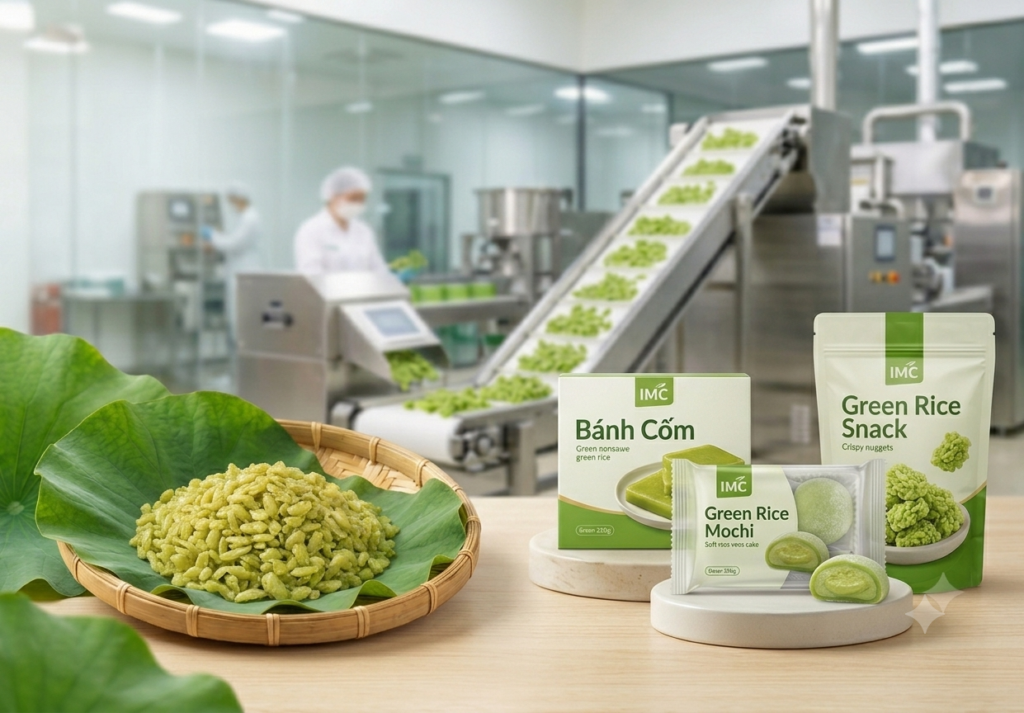
Vietnamese green rice, commonly known as cốm, is a distinctive ingredient associated with Vietnamese culinary culture. Traditionally enjoyed fresh, green rice has also become an interesting ingredient for modern food product development.
Today, Green Rice Products can take many forms, from traditional fresh cốm to green rice cake, mochi, snacks, powder, and other processed food products. While these products share the same cultural and ingredient foundation, their characteristics, applications, storage, and commercial potential can be very different.
Understanding the difference between fresh green rice and processed Green Rice Products is important for food brands, manufacturers, retailers, and businesses looking to develop Vietnamese-inspired food products.
What Is Fresh Green Rice?
Fresh green rice, or cốm tươi, is traditionally made from young rice harvested before the grains fully mature. The rice is processed through traditional steps to create its characteristic green color, soft texture, and distinctive aroma.
Fresh cốm is strongly associated with Vietnamese food culture, particularly Hanoi.
It is commonly enjoyed:
- On its own
- With bananas
- As a traditional gift
- In seasonal food products
- As an ingredient in Vietnamese desserts
Its fresh characteristics are an important part of its cultural appeal.
However, these same characteristics can also create challenges when the product needs to be distributed over longer distances or commercialized at larger scale.
What Are Processed Green Rice Products?
Processed Green Rice Products are foods developed using green rice or green rice-based ingredients and transformed into a more standardized finished product.
Examples include:
- Green rice cake (Bánh Cốm)
- Green rice mochi
- Green rice snacks
- Green rice powder
- Green rice-based confectionery
- Other customized green rice products
Processing allows manufacturers to develop products with specific formats, packaging, and product specifications for different consumer groups and markets.
Fresh Green Rice vs Processed Green Rice Products
Although both originate from Vietnamese green rice, their commercial characteristics can be quite different.
| Factor | Fresh Green Rice | Processed Green Rice Products |
|---|---|---|
| Product format | Fresh ingredient/food | Finished food product |
| Texture | Soft and naturally delicate | Can be developed for specific textures |
| Consumption | Often traditional and seasonal | Designed for different consumption occasions |
| Packaging | Usually simple or short-term | Can use retail-ready packaging |
| Distribution | More challenging | More suitable for structured distribution |
| Product development | Limited by fresh characteristics | Greater formulation and format flexibility |
| Branding | Strong traditional identity | Can combine tradition with modern branding |
| Market potential | Primarily local/seasonal | Can target domestic and international markets |
The choice between fresh and processed products therefore depends on the intended use and business model.
The Advantages of Fresh Green Rice
Fresh green rice has an important advantage: authenticity.
1. Traditional Taste and Aroma
Fresh cốm offers characteristics that are closely connected to Vietnamese culinary traditions.
Its natural aroma and texture can create an authentic food experience.
2. Strong Cultural Identity
For Vietnamese consumers and international visitors interested in Vietnamese cuisine, fresh cốm represents more than an ingredient. It is part of a broader cultural story.
3. Seasonal Appeal
Fresh green rice can have a strong seasonal association, which can make it attractive for traditional food experiences and limited seasonal products.
However, freshness also means businesses need to pay close attention to storage, transportation, handling, and consumption time.
The Advantages of Processed Green Rice Products
For commercial food brands, processed products can provide greater flexibility.
1. More Convenient Formats
Green rice can be transformed into products that are easier for consumers to purchase, store, transport, and consume.
2. Greater Product Variety
A single traditional ingredient can be used to create different product categories.
For example:
Cốm → Bánh Cốm → Mochi → Snacks → Powder → New Product Concepts
This gives brands more opportunities to develop a broader portfolio.
3. Modern Packaging
Processed products can be packaged for:
- Supermarkets
- Specialty food stores
- E-commerce
- Gift shops
- Export distribution
- Private label brands
4. Brand Development
Processed Green Rice Products can be developed under a specific brand identity, allowing companies to combine Vietnamese cultural storytelling with modern packaging and positioning.
Can Green Rice Products Be Exported?
Fresh green rice can be more challenging for international distribution because of its fresh characteristics and handling requirements.
Processed Green Rice Products, however, can provide more opportunities for international food businesses.
Depending on the specific product, manufacturers can work on:
- Product format
- Packaging
- Shelf-life considerations
- Product stability
- Labeling
- Transportation requirements
- Destination-market requirements
Export suitability depends on the specific product and destination country. Food safety, labeling, import, and regulatory requirements should be evaluated before commercial export.
From Traditional Cốm to Modern Food Innovation
One of the most interesting opportunities for Vietnamese green rice is the ability to connect traditional food culture with modern product development.
A traditional ingredient can become the foundation for products designed around contemporary consumer preferences.
For example:
Traditional Concept
Vietnamese Cốm
↓
Product Development
Green Rice Cake / Green Rice Mochi / Green Rice Snack
↓
Modern Branding
Contemporary packaging + Vietnamese cultural story
↓
Market Opportunity
Domestic retail + specialty food + international markets
This approach allows brands to preserve the cultural identity of green rice while exploring new commercial opportunities.
What Should Food Brands Consider?
For businesses interested in developing Green Rice Products, the right format depends on several factors.
Target Consumer
Is the product designed for Vietnamese consumers, tourists, Asian food consumers, or international shoppers?
Product Positioning
Will it be positioned as:
- Traditional food
- Premium gift
- Modern snack
- Specialty food
- Vietnamese cultural product?
Distribution
The intended sales channel can influence packaging and product format.
E-commerce, supermarkets, specialty retailers, and export markets may have different requirements.
Product Stability
Brands should consider how the product will perform during storage and transportation.
Packaging
Packaging should protect the product while communicating its Vietnamese identity and brand positioning.
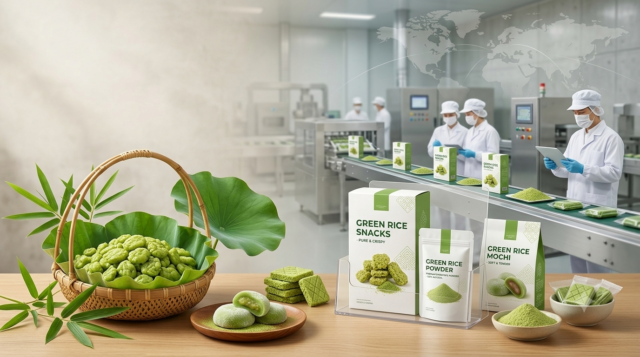
Developing Green Rice Products With an OEM Manufacturer
For brands that want to transform green rice into a commercial product, working with an experienced OEM manufacturer can simplify the development process.
A professional manufacturer can support:
- Product concept development
- Ingredient selection
- R&D
- Formula optimization
- Sample production
- Manufacturing
- Quality control
- Packaging
- Private label production
This approach allows food brands to focus on branding and market development while the manufacturer manages the technical and production aspects.
IMC – Green Rice Product Development in Vietnam
IMC supports the development and manufacturing of Vietnamese-inspired food products using green rice and other local ingredients.
Depending on the project, IMC can support products such as:
- Green rice cake
- Green rice mochi
- Green rice snacks
- Green rice-based products
- Customized Vietnamese food concepts
The development process can cover R&D, sampling, process optimization, manufacturing, quality control, and packaging, according to the specific product requirements.
By combining Vietnamese food identity with modern manufacturing capabilities, IMC helps brands explore new ways to bring traditional ingredients into contemporary food markets.
Which Is Better: Fresh or Processed Green Rice?
There is no single answer.
Fresh green rice is ideal when authenticity, freshness, seasonal experience, and traditional consumption are the priority.
Processed Green Rice Products can be more suitable when the goal is to develop a standardized product for branding, retail distribution, larger-scale manufacturing, or international markets.
For food brands, the opportunity may not be about choosing one over the other. Instead, it can be about finding the right way to transform the unique characteristics of Vietnamese green rice into products that fit modern consumer needs.
Bringing Vietnamese Green Rice to Modern Markets
Vietnamese green rice has a strong cultural foundation and considerable potential for food innovation.
From fresh traditional cốm to Green Rice Products such as Bánh Cốm, mochi, snacks, and powder, the ingredient can serve different consumer needs and market opportunities.
For brands interested in developing Vietnamese-inspired food products, the combination of traditional ingredients, modern R&D, controlled manufacturing, and contemporary packaging can create new opportunities in both domestic and international markets.
Interested in developing your own Green Rice Product? Contact IMC to discuss your product concept, OEM/private label requirements, and target market.
Contact IMC
Công ty TNHH Tư vấn Y Dược Quốc tế (IMC)
Website: www.imc.net.vn
Email: info@imc.net.vn
Hotline / WhatsApp: +84 911 818 018
From Vietnamese green rice to market-ready products — IMC supports your journey from concept and R&D to manufacturing and packaging.