


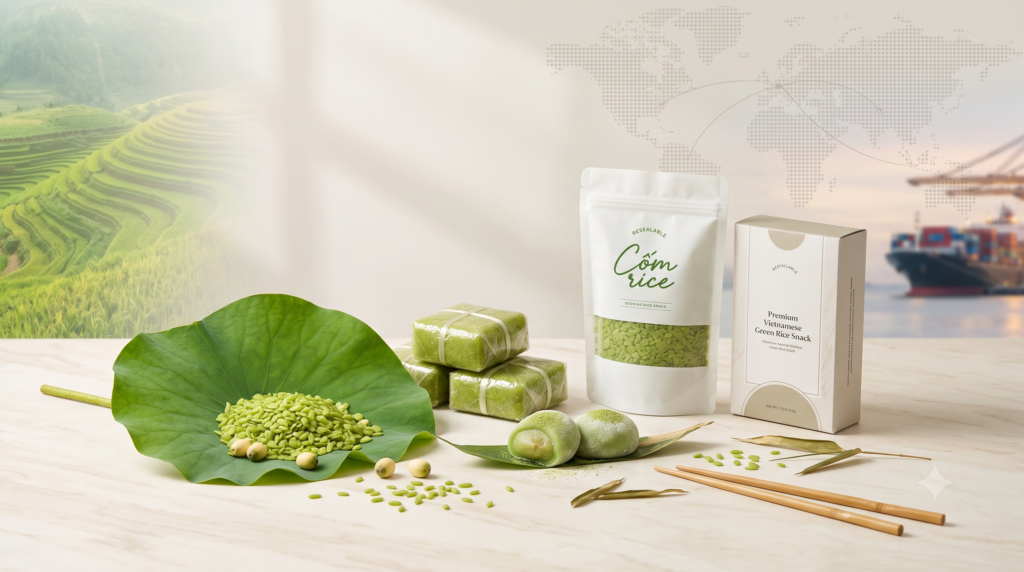
Vietnamese cuisine is gaining attention in international markets for its distinctive flavors, regional specialties, and rich culinary heritage. Among these products, green rice, known as cốm in Vietnamese, offers an interesting opportunity for food importers looking to introduce authentic Vietnamese flavors to global consumers.
For businesses planning to Import Vietnamese Food, green rice products can provide a starting point for developing a differentiated product portfolio. Traditional Bánh Cốm, green rice snacks, mochi-inspired products, and other processed green rice specialties offer different possibilities for retailers, distributors, and private label brands.
However, importing Vietnamese food involves more than selecting attractive products. Buyers need to evaluate suppliers, product specifications, food safety requirements, packaging, shelf life, logistics, and regulations in the destination market.
This guide explains the key steps international buyers should consider when sourcing Vietnamese green rice products.
1. Understand the Vietnamese Green Rice Product Market
Green rice, or cốm, is a traditional Vietnamese food made from young rice grains harvested and processed at an appropriate stage of maturity. It is particularly associated with Hanoi and northern Vietnam, where it has a strong cultural connection to autumn and traditional cuisine.
Today, green rice can be explored through different product formats, depending on ingredient availability, processing methods, product development capabilities, and target-market needs.
Common product opportunities include:
- Traditional Bánh Cốm: A Vietnamese green rice cake commonly associated with a soft green exterior and sweet filling.
- Green rice snacks: Products developed around the distinctive flavor, color, and identity of Vietnamese green rice.
- Green rice mochi-inspired products: Contemporary formats combining Vietnamese ingredients with modern snack concepts.
- Processed green rice products: Products developed for specific retail, food service, gifting, or distribution channels.
Not every supplier manufactures all these formats. Importers should confirm the available product range, formulation, processing capabilities, and commercial specifications directly with potential partners.
2. Identify the Right Products for Your Target Market
Before you import Vietnamese food, define the intended market and customer profile. A product that performs well in Vietnam may require adjustments to suit consumers, retailers, and regulations in another country.
Consider the following factors when evaluating green rice products.
Target customers
Identify whether the products are intended for Asian grocery stores, mainstream supermarkets, specialty food retailers, food service businesses, gift shops, or online channels.
Each channel may have different expectations for portion size, packaging, shelf life, pricing, and product presentation.
Product format
Fresh or short-shelf-life green rice products may require more demanding transportation and storage arrangements. Processed products with validated shelf-life specifications may be more practical for certain distribution models.
The appropriate format depends on the product itself rather than a general assumption that all processed products are suitable for long-distance export.
Taste and texture
Vietnamese green rice has a distinctive flavor and texture. Importers should evaluate samples to determine whether the product meets local consumer expectations and fits the intended category.
Packaging and positioning
Packaging can communicate Vietnamese culinary heritage while supporting practical requirements such as protection, labeling, storage, and retail display.
For premium retail or gifting channels, presentation may be particularly important. For high-volume distribution, durability, handling efficiency, and cost may carry greater weight.
3. Find a Reliable Vietnamese Food Manufacturer or Supplier
Supplier selection is one of the most important steps when planning to import Vietnamese food.
A suitable supplier should be able to explain its manufacturing capabilities, product specifications, quality-control processes, and export-related documentation.
When evaluating a potential partner, consider the following checklist:
- Product experience: Can the supplier manufacture the specific green rice product you need?
- Product specifications: Are ingredients, allergens, dimensions, net weight, storage conditions, and shelf life clearly documented?
- Quality management: Does the supplier have appropriate quality-control procedures and food safety systems for the product and facility?
- Sample availability: Can you assess product quality before placing a commercial order?
- Packaging capability: Can the supplier support packaging suitable for your distribution channel and destination market?
- Export documentation: Can the supplier provide the documents required for the shipment, subject to the destination country’s rules?
- Communication and development support: Can the supplier respond clearly to technical, commercial, and packaging questions?
Certifications and regulatory approvals should be checked for their validity, scope, and applicability to the specific product and facility. Do not assume that every Vietnamese food supplier holds the same certifications or export permissions.
4. Check Import Regulations and Food Safety Requirements
Food import requirements vary by destination country and product category. Before confirming an order, importers should identify the regulations that apply to the exact product, its ingredients, processing method, packaging, and intended use.
Key areas to review include:
Ingredient and product compliance
Confirm whether all ingredients, additives, colors, and processing aids are permitted in the destination market. Requirements may differ between countries and between product categories.
Food safety and facility requirements
Review applicable food safety requirements, supplier documentation, and any establishment registration, approval, or inspection requirements imposed by the importing jurisdiction.
Labeling requirements
Depending on the market, labels may need to include:
- Product name and description.
- Ingredient list and allergen declarations.
- Net quantity.
- Nutrition information, where required.
- Country of origin.
- Manufacturer or importer details.
- Lot or batch identification.
- Date marking and storage instructions.
- Language-specific information and other mandatory statements.
Import permits and border procedures
Some products may require advance notification, import permits, health certificates, phytosanitary documentation, or additional checks. Requirements depend on the product’s composition, processing, and destination.
For example, requirements for a processed green rice cake may differ from those for raw agricultural rice or fresh plant material.
Practical tip: Consult the destination country’s official food safety and customs authorities, or a qualified customs broker, before shipping. Confirm requirements in writing whenever possible.
5. Evaluate Shelf Life, Storage, and Transportation
Green rice products can vary considerably in moisture content, ingredients, packaging, and storage requirements. These characteristics directly affect how they should be transported and distributed.
Before importing, request documentation covering:
- Validated shelf life and the conditions under which it applies.
- Recommended storage temperature and humidity, where relevant.
- Packaging materials and product protection.
- Handling requirements during transport.
- Batch identification and traceability.
- Any restrictions on freezing, refrigeration, or temperature fluctuations.
Fresh versus processed green rice products
Fresh products may preserve a traditional eating experience but can present greater challenges for long-distance distribution. Refrigerated or frozen products may require a controlled cold chain, while shelf-stable products must have suitable processing, packaging, and validated shelf-life support.
Importers should never assume that a product is shelf-stable simply because it is packaged. Shelf life and storage conditions must be supported by product-specific evidence.
6. Request Samples and Confirm Product Specifications
Sampling allows buyers to evaluate the product before committing to a larger shipment.
For Vietnamese green rice products, sample evaluation can cover:
- Appearance and color consistency.
- Flavor, aroma, and texture.
- Filling or ingredient distribution, where applicable.
- Portion size and net weight.
- Packaging quality and ease of handling.
- Label design and retail presentation.
- Storage behavior during the intended distribution period.
For Bánh Cốm and other specialty products, importers should also consider how the product will be displayed, served, or consumed in the target market.
Once the sample is approved, document the agreed specifications clearly. This helps both parties establish a common reference for future production batches.
7. Understand Pricing, Minimum Orders, and Shipping Terms
The purchase price is only one part of the total cost of importing Vietnamese food.
A realistic cost assessment should consider:
- Product and packaging costs.
- Custom formulation or product-development costs, if applicable.
- Sampling and testing.
- Export packaging and handling.
- International freight and insurance.
- Customs duties, taxes, and clearance charges.
- Warehousing and domestic distribution.
- Potential losses, returns, or waste related to shelf life.
Ask suppliers about minimum order quantities (MOQs), production lead times, payment terms, and available shipping arrangements. These terms can vary by product, packaging configuration, order size, and manufacturing requirements.
Clarify the agreed Incoterms and the responsibilities of each party for transportation, insurance, export clearance, and import clearance. A customs broker or freight forwarder can help assess the practical implications for your shipment.
8. Consider OEM and Private Label Green Rice Products
Importing existing products is not the only way to enter the Vietnamese green rice category. Businesses seeking greater control over branding and product positioning may consider OEM or private label development.
OEM green rice products
An OEM arrangement may allow a brand to work with a manufacturer on product specifications and manufacturing requirements. The exact scope depends on the manufacturer’s capabilities and the agreed project.
Private label products
Private label development enables a buyer to explore products marketed under its own brand, subject to an agreement with the manufacturer and applicable regulations.
Potential development areas include:
- Product format and portion size.
- Ingredient and flavor specifications.
- Packaging design and presentation.
- Brand positioning for retail or gifting.
- Product documentation and destination-market requirements.
For international buyers, OEM and private label projects can provide opportunities to build a distinctive product range around Vietnamese culinary heritage.
However, customization may affect minimum order quantities, development timelines, costs, and regulatory review. These details should be agreed upon before production begins.
9. Common Mistakes to Avoid When Importing Vietnamese Food
Importers can reduce avoidable risks by addressing several issues early in the sourcing process.
Choosing a supplier based on price alone. A lower quotation may not include all packaging, documentation, testing, or logistics requirements.
Assuming all green rice products have the same shelf life. Different recipes and processes can produce very different storage requirements.
Starting production before checking import regulations. Late-stage label or ingredient changes can delay shipments and increase costs.
Failing to approve a production sample. Clear specifications and sample approval help reduce misunderstandings about quality and presentation.
Overlooking the landed cost. Freight, customs charges, storage, and domestic distribution should be included when assessing commercial viability.
Making unsupported product claims. Marketing statements, nutrition claims, and product descriptions should be accurate and compliant with the target market’s rules.
A structured sourcing process helps buyers make better-informed decisions and establish more reliable supplier relationships.
10. Partner with IMC for Vietnamese Green Rice Product Development
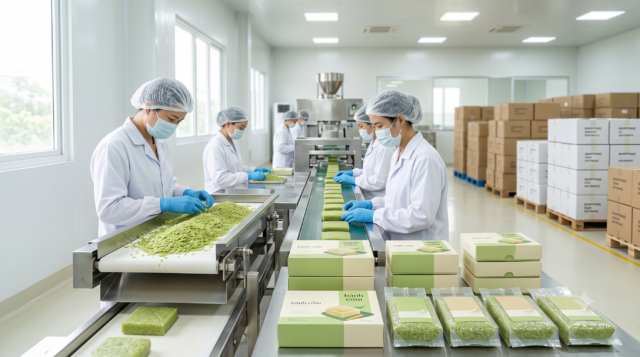
For brands and distributors interested in Vietnamese green rice products, IMC offers an opportunity to discuss product development and manufacturing requirements based on a project’s needs.
As a Vietnamese company working across functional food and consumer product categories, IMC can discuss potential OEM and private label projects, including product concepts, specifications, packaging, and manufacturing considerations, subject to technical feasibility and the agreed scope.
International buyers considering Bánh Cốm, green rice snacks, mochi-inspired products, or other green rice concepts should confirm the availability and suitability of each specific product directly with IMC.
Before moving forward, buyers can prepare a brief covering:
- Target country and distribution channel.
- Desired product format and specifications.
- Expected order volume and purchasing schedule.
- Packaging and branding requirements.
- Import compliance and documentation needs.
This information helps establish a clearer starting point for evaluating a potential manufacturing partnership.
Conclusion
To Import Vietnamese Food successfully, international buyers need a structured approach to product selection, supplier evaluation, regulatory compliance, packaging, shelf life, and logistics.
Vietnamese green rice products offer an opportunity to connect traditional food culture with contemporary retail and product-development strategies. Whether sourcing existing products or exploring OEM and private label concepts, buyers should verify specifications, documentation, and manufacturing capabilities before placing an order.
If your business is exploring Vietnamese green rice products, contact IMC to discuss potential product development and manufacturing opportunities.
Contact IMC
Công ty TNHH Tư vấn Y Dược Quốc tế (IMC)
- Website: www.imc.net.vn
- Email: info@imc.net.vn
- Hotline / WhatsApp: +84 911 818 018
Connect with IMC to discuss your Vietnamese green rice product concept, OEM requirements, and potential collaboration opportunities.